
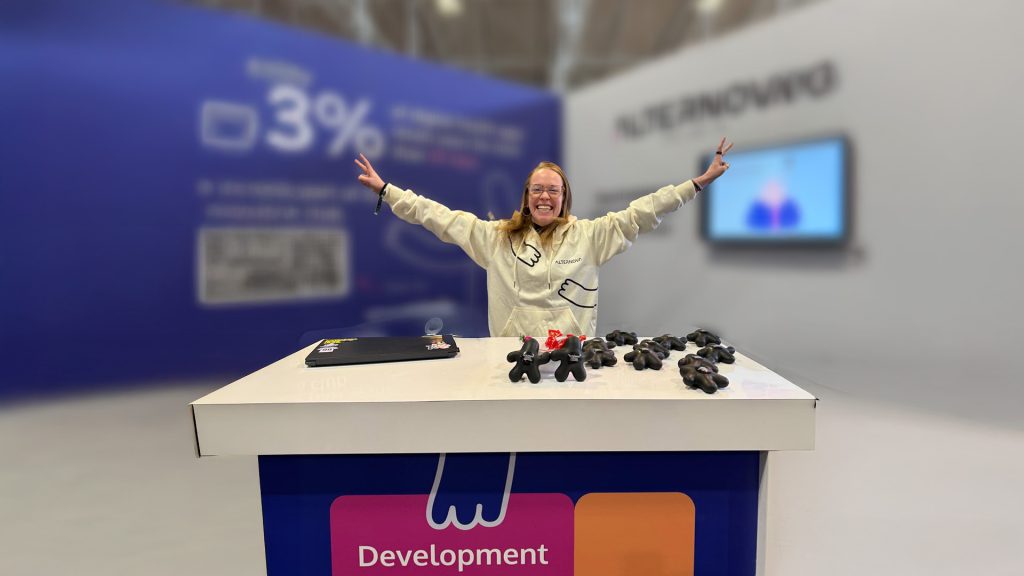
Alternova began when two longtime friends, united by a shared love of gaming, set out to create interactive experiences that could matter. Maria Clara Mesa Abad and Ricardo Velasquez launched the early stage company as a traditional video game studio, but their own mental health and spiritual journeys pushed them to reconsider what they were creating. As time went on, they felt a growing need to build technology with intention, technology that could help people flourish.
Their turning point came when they met a researcher at the University of California, San Francisco who pioneered therapeutic video game research, an area that even today remains relatively niche but foundational to the rise of FDA approved digital therapeutics and evidence based health games. Until then they had never considered healthcare as a destination for their work, but the encounter revealed something powerful. “It made us realize that if we wanted to build games, it needed to be games with intention and games with purpose,” says Mesa Abad.
That serendipitous moment opened the door to the Neuroscape lab, where Mesa Abad and Velasquez began building early therapeutic games and cognitive assessment tools grounded in neuroscience and behavioral science. What started as a research driven collaboration evolved into a new venture dedicated to using interactive media to support human well-being, an ambition that ultimately became Alternova.
An Obsession with Adherence
The more Alternova engaged with digital health, the clearer it became to them that even the most promising interventions fail if people do not stick with them. What emerged was a deeper, more structural problem: adherence. Their approach is grounded in the belief that sustaining a treatment depends less on intent and more on whether it fits naturally into a person’s routines, feels understandable and offers a sense of progress worth returning to.
“If you are having a cognitive problem where you need to do an exercise 10,000 times, what we are going to try to do is make it as interesting as possible for you to do it,” explains Velasquez. While not every task can be made fun, thoughtful design can reduce the friction that causes people to abandon treatments. They focus on strengthening engagement without trivializing the clinical goal. To do this, they draw on mechanisms from game design, including aesthetics, narrative, interaction loops and a sense of progression, and apply them deliberately within healthcare contexts.
Where Traditional Care Breaks Down
Getting patients to adhere to treatment plans has long been a persistent challenge in healthcare and is often weakened in systems that rely heavily on one-directional communication. Patients are told what to do and then left to manage complex instructions on their own. Such an approach may work in hospitals where clinicians oversee each step of care, but it becomes harder to sustain once treatment shifts into a patient’s home. Someone recovering from knee surgery, for instance, might leave hospital with a physical therapy routine, pain management guidance, mobility restrictions and follow‑up appointments, each delivered separately and expected to be coordinated without support.
“Getting better implies learning new habits and digesting a bunch of information that is not personalized or in a language that people can understand,” says Mesa Abad. This gap between clinical instruction and lived experience is where many digital health tools fall short. Alternova addresses this by grounding its products in three design principles: personalization, which adapts language and structure to individual literacy and context; micro wins, which make progress visible through small, achievable steps; and clinical integration, which connects patient behavior at home back to their care team. While this integration is technically and structurally difficult, it remains essential to achieving lasting outcomes.
Designing for Humans, Not Just Outcomes
Sustaining adherence is not only a patient challenge. It is equally shaped by the systems and professionals expected to support it. A major challenge in healthcare is creating technology that fits into clinical workflows without overwhelming clinicians or fragmenting data. However, connecting software to Electronic Health Records remains technically daunting and highly regulated. Even when integration is possible, systems in the United States rarely compensate providers for proactive care, which discourages timely intervention.
Alternova approaches these barriers by extending its human-centered design philosophy beyond patients to clinicians themselves. Rather than treating workflow constraints and compliance requirements as secondary considerations, the team designs with the day-to-day realities of healthcare professionals in mind, including time pressure, fragmented systems and limited incentives for proactive care. “We build tools that help people get better and make employees proud of the impact they create,” says Velasquez.
The Road Ahead: AI as a Personal Health Companion
Many of the challenges Alternova addresses—personalization, sustained engagement and real world adaptation—are difficult to deliver consistently through static digital tools alone. AI introduces a way to respond to patients as individuals, adjusting experiences in real time as behaviors, needs and circumstances change. Adaptive systems can tailor interventions as patients interact with them, shifting difficulty, pacing or format without requiring constant clinician input. Conversational companions and agent-based monitoring move beyond reactive chatbots, offering guidance that anticipates needs rather than waiting for prompts. In this sense, AI becomes an extension of the care team, supporting continuity when clinicians cannot be present.
Alternova’s founders are particularly focused on the potential of generative content to close the gap between clinical intent and patient understanding. Stories, visuals and instructions created dynamically for each individual can make care plans easier to absorb and more emotionally resonant. Used carefully, these tools are helping to deliver Alternova’s mission to make healthcare more human, engaging and effective, ensuring that technology helps people spend less time navigating systems and more time focusing on recovery and wellbeing.
To learn more about Alternova, follow Maria Clara Mesa Abad on LinkedIn or visit her website.